Campbell River Hearing Voices Group

The Campbell River Hearing Voices group is hosting sessions twice a month at the Shopper’s Row office! It’s now open to anyone open to learning about the hearing voices experiences, such as clinicians, therapists, friends and family members. No registration required!

If you’re in the area, check it out on the first and third Friday of every month! Call 250-850-2620 or email Stephen.Remedios@islandhealth.ca to learn more!

ECT Survey

Researchers from the University of East London are seeking individuals who have, or are close to those who have, received electroconvulsive therapy (ECT), you’re invited to take part of this international survey!

Dr. John Read, from the University of East London, is collaborating with psychologists and people who’ve had ECT themselves,to run this study. Here’s a short video interview from Dr. Read’s work.

This is your opportunity to share your experiences of this treatment, positive, negative or mixed. The survey takes about 20 minutes.

If questions about ECT or about the experiences that led you to having ECT might be distressing for you, please seriously consider not taking the survey.

If you have any general enquires about the study, please contact the lead researcher, Professor John Read: john@uel.ac.uk

The study has been approved by the University of East London Ethics and Integrity Sub-committee

You can access the survey here!

BC Hearing Voices Showcase

Join us for a gathering of vibrant talents, life stories, and perspectives from people with lived experiences of hearing voices, psychosis, and more! See the human lens and ethos in the community. Connect with authours, artists, singers, and more!

During the showcase, we will be hosting a screening of the award-winning documentary CRAZYWISE directed by Phil Borges and Kevin Tomlinson! Hear indigenous and expert opinions on psychosis and spiritual crisis! See how hearing voices is handled around the world and how people were able to find strength and build meaningful lives!

Doors open at 11:45am at Gordon Neighborhood House, situated in downtown Vancouver, nearby Robson Street! Admission is by donation! Simply pay at the door! Enjoy light food and refreshments! (First come first serve basis) Interact with community members and experience all the wonderful things we have to offer in life!

Agenda:

  • 11:45pm-12:15pm
    • Doors Open, People Mingle
  • 12:15pm-12:45pm
    • Opening Remarks and Speeches
  • 12:45pm-2:15pm
    • CRZAYWISE Screening
  • 2:15pm-2:45pm
    • Closing Remarks and Talent Showcase
  • 2:45pm-3:15pm
    • People Mingle, Doors Close

Study Club updates for spring 2024

We’re excited to announce upcoming spring dates for the Hearing Voices Study Club! Starting March 13, join us at the Study Club in-person or online for snacks and conversation. The Study Club is a casual monthly meet-up focused on sharing ideas and discussing current issues related to hearing voices and other unique sensory experiences and beliefs. The group is drop-in and open to supporters/allies. You can stay up to date on upcoming Study Club topics/activities by joining the BCHVN mailing list.

The Study Club meets every second Wednesday of the month in the Chocolate Lily Room at Mount Pleasant Neighbourhood House in Vancouver. You can now also join us virtually on Zoom! Email us at studyclub@bchvn.ca for the link. Starting in March, the Study Club will be meeting slightly later, from 6:30-8:00 pm (PST). We will not be meeting in February.

On March 13, our Study Club meeting will be a little different! Join us for a community roundtable to share your thoughts on the topics that matter to you and the activities you’re interested in. We want to hear your ideas for the Study Club! Open to all.

The venue is wheelchair accessible, and free transit tickets are available for those in need. Please email studyclub@bchvn.ca or call 778-650-6916 with any questions.

Flyer for the Hearing Voices Study Club summarizing the information listed above. It features a colourful orange and green design with images of snack foods.

This project is funded by the Consumer Initiative Fund.

Study Club dates for Fall/Winter 2023

We’re happy to announce that the Hearing Voices Study Club will be continuing to meet at Mount Pleasant Neighbourhood House in Vancouver from 6 to 7:30 pm on the second Wednesday of each month for the rest of the year (August 9th, September 13th, October 11th, November 8th, December 13th). Come join us for an evening of learning, conversation, and snacks. You can now also attend the Study Club virtually over Zoom.

The Study Club is group for watching, listening, reading, and talking about media related to hearing voices and other unique sensory experiences and beliefs. It is open to anyone, including people with lived experience, loved ones, service providers, students, and other community members who are interested in learning. Light snacks will be served, and transit tickets are available. The venue is wheelchair accessible (please email for other accessibility questions). This group is drop-in – no RSVP required. Please note that this is not a support group.

When: 6:00 to 7:30 pm on the second Wednesday of each month (August 9th, September 13th, October 11th, November 8th, and December 13th)
Where: Mount Pleasant Neighbourhood House – Chocolate Lily Room (Room 5)
800 East Broadway
Vancouver, BC V5T 1Y1

For the Zoom link to attend or any other questions, please email Anne at studyclub@bchvn.ca, or use our contact form.

This project is supported by the Vancouver Coastal Health Consumer Initiative Fund.

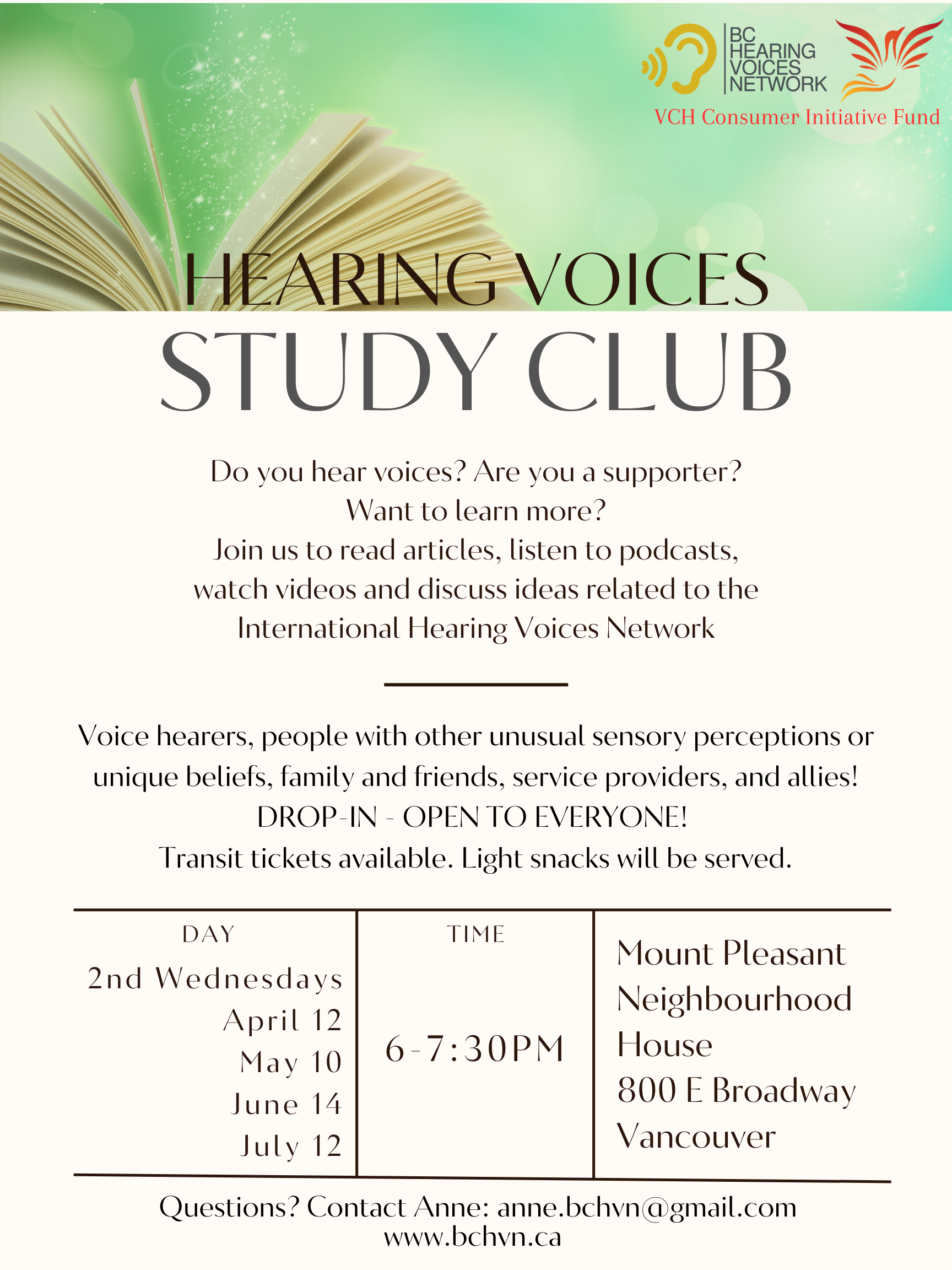
A flyer for the Hearing Voices Study Club summarizing the information above. It shows a photo of an open book with the pages turning.

New Study Club location for the spring

We’re excited to announce that the Hearing Voices Study Club is back at a new location! The Study Club will be taking place on the second Wednesday of each month at Mount Pleasant Neighbourhood House in Vancouver, from 6:00 to 7:30 pm. The Study Club is a discussion group that meets monthly to read, watch, and listen to media related to hearing voices. The group is open to anyone who hears voices, sees visions, or has other unique sensory experiences or beliefs, as well as loved ones, service providers, students, and any other community members who are interested in learning. This group is drop-in – no RSVP required.

A poster for the Hearing Voices Study Club featuring a picture of a book with open pages. The information on the poster is available as text below.

Keep reading for more information, or visit the Study Club page for the most recent updates.

Continue reading “New Study Club location for the spring”

World Hearing Voices Day

Today, September 14th, marks World Hearing Voices Day! World Hearing Voices Day recognizes and celebrates the diversity of experiences of people who hear voices, including our struggles. As Intervoice puts it,

It is a day to promote our right to define our experiences in our own way. It’s a time to expand the narrow stereotypes that still exist about voice-hearing – that it should be a source of shame and secrecy. We want to help create a world where people can talk about their experiences with those they choose – and expect an empathic response. We want to promote the idea that voice-hearing is a diverse human experience and that we need to leave judgements and assumptions at the door.

World Hearing Voices Day has been celebrated since 2006, first proposed by Louise Pembroke, an English voice hearer and psychiatric survivor who hoped to challenge negative attitudes towards the experience, specifically the assumption that hearing voices means a person is ill. Today is a day to recognize that many people live well with voices, value their voice hearing experience, and are proud to call themselves voice hearers. However, it’s also a day to recognize complexity – including the fact that for many other people, hearing voices is difficult, upsetting, or not something they want to be a big part of their identity. There are as many ways to hear voices as there are people who hear voices, and building a community where we’re able to share our many, varied, often messy experiences without judgment is central to the Hearing Voices Movement. As HVN England wrote in a 2020 blog post,

World Hearing Voices Day is a day to celebrate the strength and diversity of those of us who hear voices. It’s a day to lift up our stories (in all their complexity). It’s a day where those of us who can speak about voices openly (without fear of being bullied, harmed or coerced) can say ‘Here I Am!’ and hopefully create the kinds of conversations that help erode some of the silence and shame surrounding voice-hearing.

A key tenet of the Hearing Voices Movement, and our network, is that voice-hearing is a diverse human experience and that there is no single truth about voice-hearing that fits everyone. We are interested in people’s own ways of making sense of their experiences … in the relationship they have with the voices they hear or the visions they see. Whatever your experience of voices, visions, smells, presences, tactile sensations or tastes – you’re welcome here.

To celebrate World Hearing Voices Day, try some of these suggestions from Intervoice:

  • Hosting, or going to, an event (for example, the Hearing Voices Study Club will be meeting for its inaugural session today, September 14th in Vancouver; or, here’s an upcoming by-donation webinar hosted by ISPS-US featuring author Ruth Ozeki and members of the HVN-USA)
  • Using the day to talk about ‘hearing voices’. Share some of Intervoice’s essential facts and promote some discussion with friends, colleagues and relatives.
  • Using social media to raise awareness (for example, by tweeting about voices and visions with the hashtag #WorldHearingVoicesDay)
  • Downloading and sharing Intervoice’s postcards with quotes from voice-hearers on your website or social media (or making your own!)

Hearing Voices Study Club at Kits House

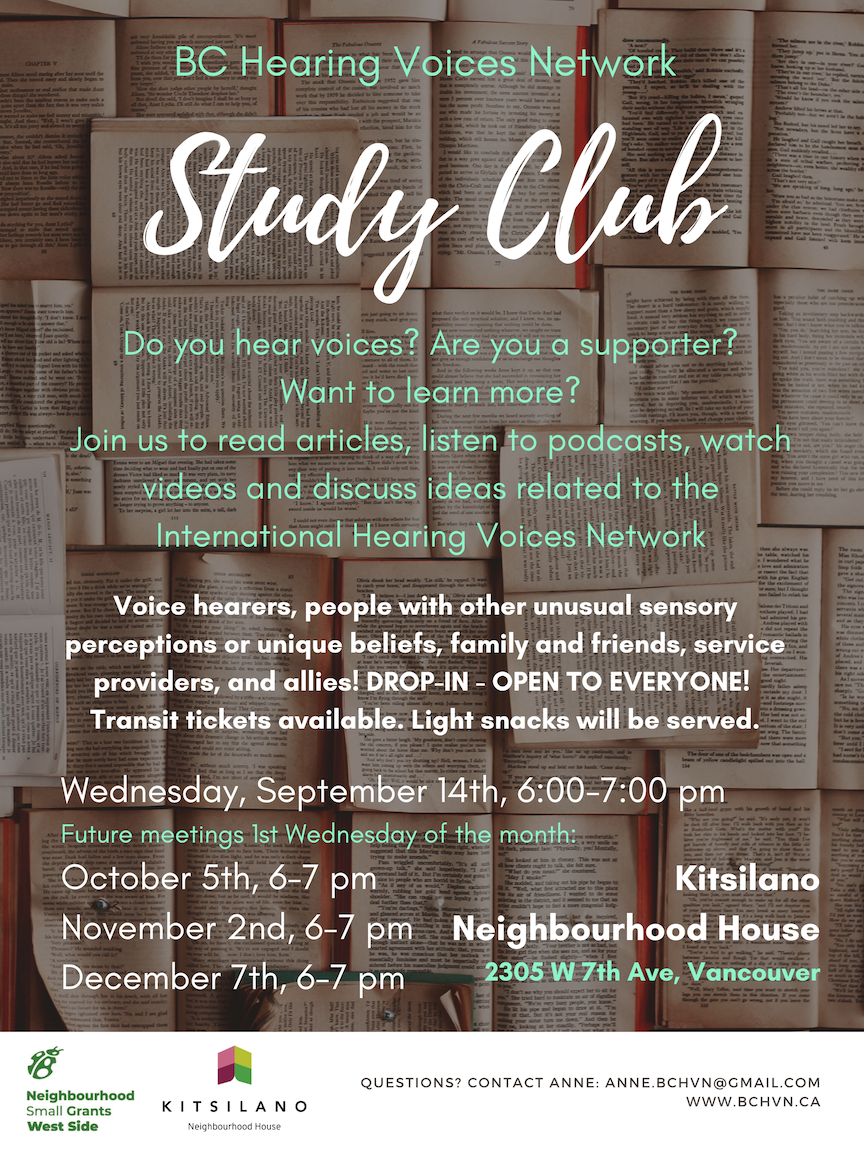
The Hearing Voices Study Club is back! We will be meeting monthly at Kitsilano Neighbourhood House to read, watch, and listen to media related to hearing voices. The group is open to anyone who hears voices, sees visions, or has other unique sensory experiences or beliefs, as well as friends and family, service providers, students, and any community members who are interested in learning. The group is drop-in and open to everyone. Note: this is a social/discussion group for sharing our ideas and reflections, not a treatment group.

The first meeting will be on September 14th from 6-7 pm at Kitsilano Neighbourhood House (Vancity Room), 2305 W 7th Ave. Future meetings will be on the first Wednesday of each month from 6-7 pm on October 5th, November 2nd, and December 7th. Transit tickets are available on request and light snacks will be served. The venue is wheelchair accessible.

For more information, please contact Anne: anne.bchvn@gmail.com

A flyer for the Hearing Voices Study Club summarizing the above information

Research participants wanted for study on reducing distress related to voices

Researchers at the University of Toronto are recruiting participants for an online study focused on methods to help reduce the distress some people experience when they hear voices. If you’re interested in participating, or for more information, please contact Talia Leibovitz at t.leibovitz@mail.utoronto.ca or 647-689-6098 Ext. 103. Please see the flyer below (or click to download the .pdf version).

Yale COPE Project

Yale University is conducting a study to understand perceptual experiences like hearing voices, seeing visions, or smelling, tasting, or feeling things that other people don’t, and what makes some people more able to control their experiences. They are currently looking for participants to complete a series of online surveys. You can find out more about the project by visiting the COPE Project website, or reading the FAQ page. From the COPE Project website:

People everywhere have experiences like hearing voices and seeing things other people don’t. Sometimes, these are part of mental illness. Often, however, they occur in healthy individuals. There are usually a few differences between the experiences of people who seek psychiatric care and people who don’t. One difference is the ability to regain empowerment in the distressing life experiences that aren’t working for them–specifically with perceptual experiences. For example, many people say they can schedule times for when their voices (whether they consider them voices, aspects, guides, spirits, etc.) can talk to them. 

Influence over our experiences is complex. It involves neurological, psychological, and social factors. Today, there is no way to measure the ability to influence perceptual experiences. 

We have made the first tool to study these experiences. It will help us design new treatments for individuals to gain empowerment in voice-hearing and other perceptual experiences. But we need your help! 

Participants can be people with experiences of seeing, hearing, or feeling things others might not be who have influence (or control) or people who do not have influence (or control) over these experiences.

Behind the COPE Project is a team of individuals from all different communities–neuroscientists, therapists, mental health professionals, mental health advocates, individuals with lived experiences, and individuals who view their experiences as spiritually oriented. Our group is called the SPIRIT Alliance (SPIRIT meaning the multitude of characteristics that make up an individual). 

Our goal: to understand clinically the extraordinary experiences of real people. 

Share your experiences with us! Understanding how you can influence your perceptual experiences can help those who can’t do it themselves. This can inform new treatments for people who struggle with distressing experiences.

Our goals are:

 To learn from those who hear, see, and feel things others can’t/don’t
• To understand the ways people can control these experiences and their lives
• To create new treatments for those who need them.

Participation:

•  Is online, from the comfort of your own home. 
•  Is paid.
•  Involves taking surveys, playing games, and sharing your story.

Statement on the BCCDC’s findings on mortality during the 2021 heat dome

Content warning: discussion of ableism and health inequality

The Tyee recently published a summary of a BC Centre for Disease Control Environmental Health Services presentation (viewable here) analyzing deaths that occurred this summer during the catastrophic heat dome. The presentation concluded that “people with schizophrenia were at four times higher risk [of death] during the heat dome” – above and beyond people living with cardiovascular conditions, Alzheimer’s, or dementia. This finding is tragic, infuriating, and unacceptable. Unfortunately, for some of us who have been diagnosed with schizophrenia, it may not be surprising. People diagnosed with schizophrenia experience high rates of poverty, social isolation, lack of access to medical care, chronic physical illness, interpersonal violence, and other factors that can lead to worse health outcomes, including shorter life expectancy. This is not a result of the individual experiences (e.g. hearing voices) leading to diagnosis. It is a social problem resulting from discrimination and deep inequality. This is a failure of access: to social support, to safe and trustworthy medical care, to proper housing to rest in, to green spaces to cool off. It doesn’t have to be this way.

As the climate crisis progresses, the impacts will be felt disproportionately by the most marginalized in society, including people with psychosocial disabilities, Mad people, voice-hearers, and others. Responding to the challenges posed by extreme weather is a mental health and disability justice issue, and will require building strong communities. Together, we’re resilient. Please look out for one another.

During the heat dome, one volunteer-run project that helped to distribute water and cold drinks to those in need around the Lower Mainland was the Vancouver Community Fridge Project. If you’re interested in learning more about the project or getting involved, click here.

National Day for Truth and Reconciliation

I’d like to acknowledge today as a day of reflection and mourning, while also recognizing that, because National Day for Truth and Reconciliation is not a statutory holiday in BC, many people haven’t been able to take the time off work today to grieve for their families and communities.

The ongoing legacies of colonization, occupation, cultural genocide, and intergenerational trauma are deeply intertwined with health and wellbeing – emotional, physical, and spiritual. Understanding the histories and present day realities of the land we live on and the communities we live in is an important part of understanding ourselves, including, for many people, our experiences with voices and visions.

If, like me, you’re a settler on the land where you currently live, I’d like to extend a few opportunities for learning and giving today. One place to start is by making a financial contribution to an Indigenous-led charitable organization: https://www.onedayspay.ca/

You can also view the ODP guide to deeper engagement, which has a list of questions to ask yourself as a starting point to learn more about the land you’re on, the communities around you, the histories you share, and your relationship to settlement.

If you’re not sure whose territory you’re on, some websites that might help as a starting point include:

If you haven’t read the Truth and Reconciliation Commission of Canada’s Calls to Action, you can find them here: https://www2.gov.bc.ca/assets/gov/british-columbians-our-governments/indigenous-people/aboriginal-peoples-documents/calls_to_action_english2.pdf

If you aren’t familiar with the United Nation’s Declaration on the Rights of Indigenous Peoples, you can find a guide to understanding it here: https://www.indigenousbar.ca/pdf/undrip_handbook.pdf

You can watch (live or recorded) video events streamed by the National Centre for Truth and Reconciliation here: https://nctr.ca/education/trw/general-public-schedule/

I hope everyone is able to reflect and/or act in whatever ways feel right, and I hope the rest of today is as gentle as possible for everyone who’s struggling. If you’re Indigenous and in need of support, you can call the following crisis line numbers 24/7:

New Intervoice website and BC Hearing Voices Network updates

Intervoice website and World Hearing Voices Congress

Exciting news! Intervoice, the umbrella organization which connects local Hearing Voices networks around the globe, has launched its new website. You can check it out here: https://www.intervoiceonline.org/ The Intervoice website compiles news, resources, and research on the topic of hearing voices in an accessible, open-ended format, as well as a directory of Hearing Voices networks around the world. Intervoice also recently hosted the (virtual) 12th annual World Hearing Voices Congress in Cork, Ireland, where myself (Rory Higgs) and Anne Liao of the BC Hearing Voices Network were grateful to have the opportunity to speak about our vision for community- and rights-based approaches to voice hearing. Recordings from the Congress should be available online shortly.

BC Hearing Voices Network updates

We are hoping to restart the Hearing Voices Study Club, a discussion group focused on articles, research, and personal stories related to the topic of hearing voices (potentially in a virtual, province-wide format). If you’re interested in receiving Study Club updates, please contact admin@bchvn.ca. We will also be introducing regular province-wide virtual meetings to support group facilitators and organizers. If you’re considering starting a group locally and are interested in attending an upcoming meeting, please contact admin@bchvn.ca for more information!